Learning the names of family members is one of the most important first steps when learning a new language. In Italian, family terms can be slightly different from those in other languages, so it is important to know them well. In this article we will look at the most common terms and use them in simple sentences to help you remember them.
Kinship terms
Let’s start by exploring the Italian vocabulary related to family. This list will introduce you to the most common terms related to family and will help you to describe your family relationships.
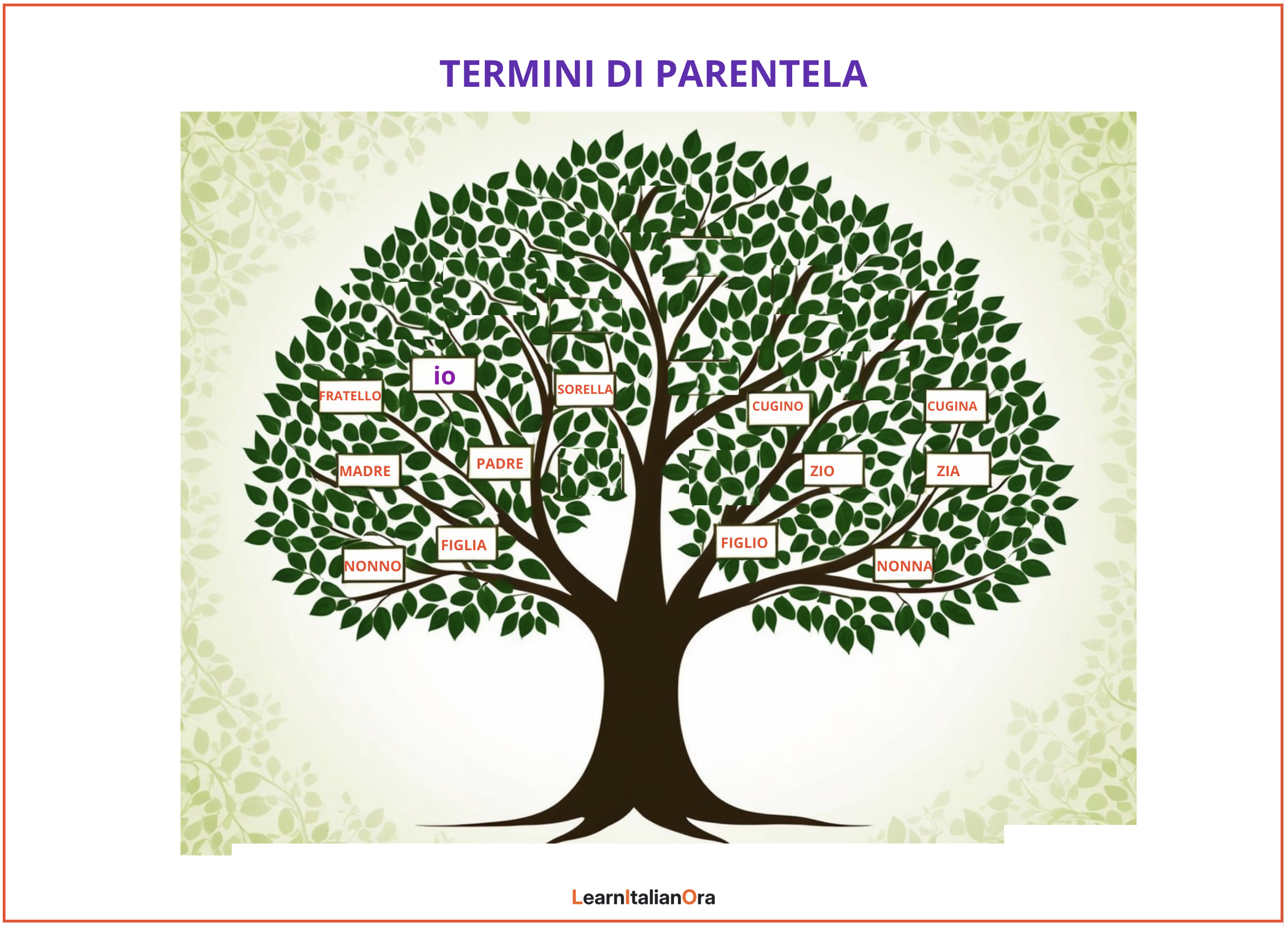
Here is a list of the most common kinship terms:
Padre / Father
Papà / Dad
Mamma / Mum
Madre / Mother
Fratello / Brother
Sorella / Sister
Nonno / Grandfather
Nonna / Grandmother
Zio / Uncle
Zia / Aunt
Cugino / Cousin (male)
Cugina / Cousin (female)
Figlio / Son
Figlia / Daughter
Marito / Husband
Moglie / Wife
Genitori / Parents
Figli / Children (plural of son/daughter)
Possessive adjectives and surnames
In the previous article we talked about possessive adjectives such as “mio“, “tuo“, “suo“, etc. Now let’s see how to use them together with family terms.
With singular, unmodified close-family terms, the article is usually omitted: mio padre, mia sorella. Use the article with plural family terms, with loro and when the family term is modified: i miei genitori, il loro zio, la mia cara mamma.
Let us look at some examples:
Mio padre (no article because it is singular)
I miei genitori (we use the article ‘i‘ because it is plural)
La mia cara mamma (the article ‘la‘ is used because there is the adjective ‘cara‘).
Remember that the possessive ‘loro‘ always takes the article, even for a single family member:
Il loro cugino (‘cugino‘ is singular, always with the article)
Le loro cugine (‘cugine‘ is plural, always with the article)
Some other examples:
- Mia madre è gentile.
- Tuo padre è simpatico.
- Suo fratello è alto.
- I suoi fratelli sono alti.
- Nostra sorella è intelligente.
- Le nostre sorelle sono intelligenti.
- Vostro nonno è affettuoso.
- I vostri nonni sono affettuosi.
- Il loro zio è bello.
- I loro zii sono belli.
To conclude
Kinship terms in Italian are not difficult, but it is important to be aware of the use of articles with possessive adjectives. The general rule is that the article is not used for individual family members (in the singular) unless there is a descriptive adjective or it is the possessive ‘loro‘.
Practise what you’ve learned
Check your understanding, then try again if you need to.
Exercise 1 of 3
Who is this person?
Choose the correct family word.
La madre di mia madre è mia ___
Il padre di mio padre è mio ___
Il fratello di mia madre è mio ___
La sorella di mio padre è mia ___
Luca e io abbiamo gli stessi genitori. Luca è mio ___.
Anna e io abbiamo gli stessi genitori. Anna è mia ___.
Il figlio di mio zio è mio ___
La figlia di mia zia è mia ___
Exercise 2 of 3
Male or female form?
Choose the correct word.
father’s father
mother’s mother
male sibling
female sibling
male cousin
female cousin
uncle
aunt
Exercise 3 of 3
Family + possessives
Choose the phrase matching the possessor and family noun in brackets. Follow the standard article pattern practised in the examples.
___ è insegnante. (io, madre)
___ vivono a Roma. (io, fratelli)
___ vive a Milano. (loro, padre)
___ vive a Torino. (io, sorella preferita)